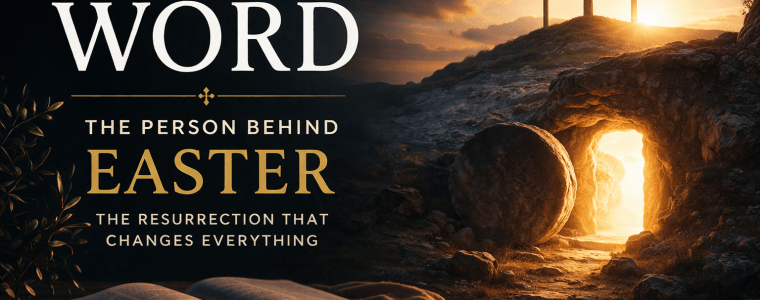
“Beyond the Word — The Person Behind Easter”

There is something deeply revealing about how we often approach meaning. We tend to fixate on words—where they came from, what they once meant, how they evolved. And so, when it comes to Easter, many ask: Where did the word come from? Was it rooted in ancient myths? Was it borrowed from pagan traditions?

But perhaps the more important question is not about the word… but about the person.

Because Christianity was never built on mere words. It was built on a person. The person of—Jesus Christ.

You see, if Easter were merely about terminology, then its power would be linguistic. If it were about tradition, its influence would be cultural. But Easter is neither sustained by vocabulary nor confined to ritual. It is anchored in history—specifically, in the resurrection.

The profound claim of the Christian faith is this: that Jesus Christ, having been crucified, did not remain in the grave. He rose again. And in that act, something far greater than symbolism took place. A transaction occurred—one that addressed the deepest human dilemma.

For centuries, humanity has wrestled with the problem of guilt, of moral failure, of separation from what is good, pure, and holy. Philosophies have attempted to explain it. Religions have attempted to manage it. But the message of Easter declares that it was resolved—not by human effort, but by divine intervention.

The cross was not merely an execution; it was a substitution. And the resurrection was not merely a miracle; it was a validation.

It validated that the sacrifice was sufficient.

It validated that death was not the end.

And it validated that salvation was not an abstract idea, but a finished work.

This is why the focus cannot remain on the word “Easter.” Words can be debated. Origins can be disputed. But the person of Christ confronts us with something far more compelling—truth that demands a response.

The heart of the Christian message is not merely what is taught, but who is presented. Christianity does not ask you simply to accept a principle; it invites you to encounter a person.

And that changes everything.

Because if the resurrection is true, then hope is not wishful thinking—it is grounded reality.

If the resurrection is true, then forgiveness is not earned—it is offered.

And if the resurrection is true, then life is not ultimately defined by death—but by what lies beyond it.

So, the next time we hear the word “Easter,” perhaps we should pause—not to analyze its etymology, but to consider its implication.

Not the word… but the person.

Not the tradition… but the truth.

Because at the center of Easter is not a concept to be studied, but a Savior to be known.

“For God so loved the world that he gave his one and only Son (Jesus), that whoever believes in him shall not perish but have eternal life.” (NIV) – John 3:16

Happy Resurrection Day !!

The Light Of The World

“When Jesus spoke again to the people, He said, ‘I am the light of the world. Whoever follows me will never walk in darkness, but will have the light of life.’”
— John 8:12 (NIV)


💡 Reflection

Diwali is celebrated as the victory of light over darkness, good over evil, and truth over falsehood. As followers of Christ, we find this theme fulfilled perfectly in Jesus, who didn’t just bring light — He is the Light.

Darkness represents confusion, fear, sin, and separation from God. The world often tries to overcome this darkness with temporary lights — success, comfort, or relationships. But these fade.

Jesus, however, offers a light that never goes out — a light that leads us to eternal life and gives clarity, peace, and purpose.

When we invite Jesus into our hearts, His light shines through our words, our actions, and our love. We become lamps in His hands, reflecting His brilliance in a dark world.

So, as diyas (lamps) and candles glow around you today, pause and thank God for the true Light — the One who dispels every shadow within and around us.


🙏 Prayer

Lord Jesus,
On this day when so many lights shine across our cities and homes,
Help me remember that You are the true Light of the world.
Chase away the darkness in my heart — fear, doubt, pride, and sin.
Let Your light shine through me so that others may see Your love and truth.
May my life reflect Your glory today and always.
Amen.

Navigating Family Challenges with Faith

Family life is a beautiful gift, but it’s not without its storms. Between juggling responsibilities, resolving conflicts, and facing unexpected hardships, it’s easy to feel overwhelmed. Sometimes, these challenges can subtly—or not so subtly—pull us away from our relationship with God. The demands of parenting, a strained marriage, or financial pressures can leave us distracted, exhausted, or even questioning our faith. But the Bible offers us hope, wisdom, and practical examples to stay rooted in God, no matter the season.

Here’s how we can navigate family challenges without letting them distance us from the Lord, with lessons drawn from Scripture.

1. Recognize the Pull and Refocus on God’s Presence

Life’s pressures can make us feel like God is distant, but often it’s our focus that shifts. Take the story of Martha and Mary in Luke 10:38-42. Martha was busy serving, distracted by her many tasks, while Mary sat at Jesus’ feet, listening to Him. Martha’s frustration boiled over, and she even questioned Jesus: “Lord, don’t you care that my sister has left me to do the work by myself?” (v. 40, NIV). Jesus gently corrected her, saying, “Martha, Martha, you are worried and upset about many things, but few things are needed—or indeed only one. Mary has chosen what is better, and it will not be taken away from her” (v. 41-42)


In family life, we can become like Martha—caught up in the chaos of schedules, bills, or sibling squabbles. It’s not that our duties don’t matter; it’s that they shouldn’t eclipse our time with God. When you feel the pull, pause. Refocus. Even a short prayer or a moment of gratitude can recenter you on His presence.

2. Lean on God’s Strength, Not Your Own

Family challenges can drain us emotionally and physically, tempting us to rely solely on our own grit. But Scripture reminds us that God’s strength is available when ours runs out. Look at the example of David in 1 Samuel 30:6. His family had been taken captive by the Amalekites, and his men were ready to turn against him. The Bible says, “David was greatly distressed… But David found strength in the Lord his God.” Instead of despairing, he sought God’s guidance and went on to recover everything that was lost.


When your family faces a crisis—whether it’s a health scare, a rebellious child, or a fractured relationship—turn to God first. Philippians 4:13 declares, “I can do all this through him who gives me strength.” You don’t have to carry it alone; God’s power is bigger than any challenge.

3. Guard Against Bitterness with Forgiveness

Family life can breed hurt—arguments with a spouse, disappointment in a child, or tension with in-laws. If unchecked, resentment can creep in and harden our hearts, pushing us away from God’s love. The story of Joseph in Genesis 37-50 is a powerful example. Sold into slavery by his brothers, he had every reason to grow bitter. Yet, years later, when he faced them again, he said, “You intended to harm me, but God intended it for good” (Genesis 50:20).


Ephesians 4:31-32 urges us, “Get rid of all bitterness, rage and anger, brawling and slander, along with every form of malice. Be kind and compassionate to one another, forgiving each other, just as in Christ God forgave you.” When family strife tempts you to pull away from God, lean into forgiveness instead. It’s not easy, but it keeps your heart aligned with Him.

4. Prioritize Prayer as a Family Lifeline

When life gets hectic, prayer can feel like just another task to squeeze in. Yet, it’s our direct line to God, especially in tough times. In Acts 12, Peter was imprisoned, and his situation seemed hopeless. But the church—his spiritual family—“was earnestly praying to God for him” (Acts 12:5). God answered dramatically, sending an angel to free Peter from his chains.


In your family, make prayer a habit, not an afterthought. Whether it’s a quick prayer over breakfast or a deeper time of seeking God together during a crisis, it invites His peace and guidance. Philippians 4:6-7 promises, “Do not be anxious about anything, but in every situation, by prayer and petition, with thanksgiving, present your requests to God. And the peace of God, which transcends all understanding, will guard your hearts and your minds in Christ Jesus.”

5. Trust God’s Timing and Purpose

Sometimes family challenges—like a wayward child or a prolonged struggle—make us doubt God’s goodness or timing. The story of Abraham and Sarah in Genesis 15-21 shows us how to hold on. God promised them a son, but years passed with no answer. Sarah even laughed at the idea in her old age (Genesis 18:12). Yet God fulfilled His promise with Isaac, proving His faithfulness.


When your family feels stuck, cling to Romans 8:28: “And we know that in all things God works for the good of those who love him, who have been called according to his purpose.” Trust that God is weaving even your hardships into something redemptive.

Staying Close to God Amid the Storm

Family life will always have its challenges—messy, beautiful, and everything in between. But those struggles don’t have to pull you away from God. Like a compass in a storm, Scripture and prayer can guide you back to Him. Psalm 46:1 reminds us, “God is our refuge and strength, an ever-present help in trouble.” When the waves hit, He’s not far off—He’s right there, ready to steady you.


So, take a deep breath. Look to these biblical examples. Lean into God’s Word and presence. Your family life, with all its chaos and joy, can be a place where your faith grows stronger, not weaker.

Be Consistent in Doing God’s will

“I came down from heaven, not to do My own will, but the will of Him Who sent Me” ( John.6:38 ). 

Jesus tells us here in His own words what He came on earth to do. And in this one sentence we have a description of how Jesus lived every single day of His entire life on earth. The thirty years of Jesus’ life in Nazareth are referred to as hidden years. But here Jesus reveals what He did during every day of those 30 years. He denied His own will and He did His Father’s will.

Jesus was tempted in different situations for 30 years in Nazareth. It is written about those hidden years that “He never pleased Himself” at any time ( Rom. 15:3 ). He always denied Himself. Thus He pleased the Father at all times. Pleasing oneself can be done in many areas of one’s life – for example, in the area of eating. Consider a situation where, even when you are not hungry, you decide to spend some money to buy some tasty snacks to eat. There is certainly nothing sinful or wrong in that. But it speaks of a certain way of life. Because you have money, you buy what you like, whether you need it or not. You do what pleases yourself. If you feel like buying something you buy it. If you feel like going somewhere, you go. If you feel like sleeping late, you just sleep late. What is the end result of living like that, even if you go regularly to the meetings and read your Bible every day? You may not lose your salvation, but you will certainly waste the one life that God gave you to live for Him.

When Jesus was with the Father in heaven from eternity past, He never had to deny His own will, for His own will was the same as His Father’s. But when He came to earth in our flesh, that flesh had a self-will that was diametrically opposed to the Father’s will at every single point. The only way in which Jesus could do His Father’s will then was by denying His own self-will all the time. This was the cross that Jesus bore throughout His earthly life – the crucifixion of His own will – and which He now asks us to bear every day, if we are to follow Him. It was the consistent denial of His own will that made Jesus a spiritual Man. And it is the denial of our self-will that will make us spiritual too.

Consider a situation where you are visiting your home after a tough day at work and you are tempted to say something negative about a certain person in your family. What do you do? Will you yield to that temptation and backbite, or will you deny yourself and keep your mouth shut? Many imagine that such a sin will not destroy their lives. But, it is only in eternity that many brothers and sisters will realize how every time they pleased themselves, they destroyed themselves a little. Then they will regret the way they wasted their lives on earth.

Spirituality is not something that comes through one encounter with God. It is the result of choosing the way of self-denial and of doing God’s will CONSISTENTLY day after day, week after week, and year after year. 

Mature Christians are those who “because of practice (in exercising their will in the right direction through many years), have their senses trained to discern good and evil” ( Heb.5:14 ). Determine that you will become a true man/woman of God.

Prayer:

Loving heavenly Father,

Help me to yield to your will at all times in my life.
Help me to deny my self and walk in your will always.
Show me the ways in which I should walk. Help me to make the right decisions.
Give me the strength to overcome every temptation that makes me please myself.
And Lord, give me the wisdom and courage to walk consistently in your will.
May only your will prevail in my life.

Amen.

Listen to God Before You Make Decisions

Prayer is not only speaking to God but listening to Him as well. And listening is more important than speaking to Him. Consider: If you were speaking with an important person whom you know is much elder and wiser than you on the phone, you would listen much more than you speak, isn’t it. So, must it be in true prayer – you must listen to God much more than you speak to Him.

If you are very keen on doing something, you can easily deceive yourself that it is the will of God, by praying about it briefly just to ease your conscience, and then saying to yourself that you feel “at peace in your heart” about doing it – and go ahead and do it! That way you can miss the will of God completely.

The more important the decision you have to make, the more you must wait on God before you act.

There is as much difference between your way of thinking and God’s thoughts as there is between earth and heaven (Isa.55:8, 9). God’s way of doing things is far higher than yours. That is why God wants that we must submit to Him – to get His best.

You may not have much time to spend in prayer. But you must have the attitude of waiting on the Lord in making your decisions. And so, discipline yourself to spend a few minutes with God every day. God wants to communicate with you every day. This is the message that comes across from the first page of the Bible, where it says: “ On the first day, God spoke…. On the second day, God spoke…….On the third, ……..fourth, ……..fifth and sixth days, God spoke ”. Something happened each day when God spoke, and the final result was “ Very Good”. So, it can be with your life too, if you listen to God every day. Jesus said, “ Man shall live by every word that proceeds from the mouth of God” (Matt.4:4).

God always wants to answer our prayers. But we must earnestly wait on Him for an answer. Sometimes His answer may be ”No.” Sometimes it may be “Wait”. Like the red, yellow, and green traffic lights.

Prayer :

Loving Heavenly Father,

Help me to wait for you before making any important decisions in my life. Help me to not get carried away by my own fleshly desires and worldly pressures. Help me to always depend on your wisdom, pray and seek counsel from you. Guide me through your Holy Spirit who is within me to face the challenges outside and surrounding me. Thank you Lord, for you are a loving God and Father who always listens to your children and gives them your best. May your best happen in my life always.

In Jesus Name,

Amen

A New Beginning

Therefore, if anyone is in Christ, this person is a new creation; the old things passed away; behold, new things have come

2 Corinthians 5:17, NASB

Happy New Year beloved reader. I wish good health and prosperity to you and family!!

Wow its already 2023 and another year has passed. And in the midst of so much chaos around the world. We are finding ways to live and move on with our lives. But for all of us a new year brings new hope and desire for something bigger and better than last year.

Some of us try to retrospect what we do right and wrong in the previous year. Areas we improved or need to improve. Successes and failures. And after all that we do try to come up with new year resolutions which sometimes or always gets resolves to an end by themselves. If you understand what I mean 🙂

So, in light of that, I want to put forth that this devotional is not going to be encouraging to start coming up with new year resolutions neither it’s going to be asking us to retrospect the last year. But I do want you to ask this question?

Would believing in Jesus still make a difference in 2023?

With so much uncertainty around every area of our lives, be it family, job, finances, relationships etc. Where does Jesus stand or makes sense? What can he do? Is it even logical to believe in Jesus today? We do trust our leaders of our respective countries to make a difference. Democratic or Republic or Kingdom. Yet some problems are bigger than the human race. Think about all the natural disasters, pandemic, moral wrong doings, terrorism, deaths, forgery and wars we had or are going through. Yet some of them are getting hard to be resolved by all of our strengths combined. Don’t you think we all are working to resolve these issues for so many years now? Inventions, regulations, unions, governments, rules, militaries, weapons and still the issues are not getting resolved.

Therefore, that brings us to the question What is the real problem? The bible says the below,

For out of the heart come evil... Mathew 15:19 NIV

If you can just ponder for some time on the origin of all the issues, we face today. It comes from the evil of our hearts. We talk so much about failures of governments, humanity, morals, military and leaders. But we fail to realize that the issues we face today are not born out of these institutions we humans created for service of mankind. But mankind itself created the issues.

Let’s see an example, why do people steal? Is it because they want to, or the lack of something. It’s hard to distinguish, isn’t it? Because it’s not always the lack. It may be other moral motives, like lust, power, greed, selfishness, laziness etc. or it could be just sheer want for something to live. But the origin of all this is the thought that originated from an idea that came to the mind of someone. And when they gave into the idea, the body performed it. We could apply this to almost every issue we face.

We human race have evolved over the years and have resolved many issues. But let’s admit we cannot change a human heart. We don’t have a cure. Thats where Jesus comes in.

Now you may ask, how can a person or spiritual entity bring a change in a human heart? How can that be possible? I love the below bible verse which says

.... Humans look at outward appearances, but the Lord looks into the heart. - 1 Samuel 16:7 GWT

How can God look into our heart? It’s pretty simple. He is the one who created us. Just like we can look deep within something we created. We know ins and out of our own inventions. God can see through what he invented. We are his priceless creations, whom he loves no, matter who we are. “For God shows no partiality” – Romans 2:11.

You know what, I can give a thousand reasons to believe Jesus. But it just takes just 1 step to know for yourself. It’s like you can hear a thousand reasons from others on how good a dish is but you can’t tell for yourself if its good until you taste it yourself. Can you take that 1 step? Like we try and see so many things in our lives before taking a decision. Can you try Jesus? Give him just 1 chance look into your heart. He can cure as he himself said … I am the LORD, who heals you. – Exodus 15:26. He is the best doctor we have for all of our issues. And he is the best bet for humanity. The only obstacle to us having to know Jesus is first to admit we need a cure and second how to know him. Thankfully for us there is open an invitation for everyone. Jesus said,

Here I am! I stand at the door and knock. If anyone hears my voice and opens the door, I will come in and eat with that person, and they with me. - Revelation 3:20

This new year, you may want to try out many things. But try out Jesus too. You will never regret. I am a testimony. Life has never been the same after I accepted Jesus. Many can testify with me. We may miss many things in our lives. Let’s try our best to not miss and chance to experience Jesus.

Once you make a decision just say this prayer

Dear Lord, I admit that I am a sinner. I have done many things that don’t please you. I have lived my life for myself only. I am sorry, and I repent. I ask you to forgive me. I believe that you died on the cross for me, to save me. Come into my life and change me.

If you have said the above prayer. Congratulations. The next step for you is to know God and his word. Grab a bible and read any Gospels to start with. You will get to know about Jesus more. If you need a bible. You can contact us and we will send it to you for free. Try to join a local church and enjoy a fellowship of co-believers just like you. If you wish, reach out to us for help, we will be happy to help and guide you to the next steps.

If you are a believer of Christ, please do share this devotional to someone who may need it, prayerfully. And if you feel there have some areas in your life which needs Jesus to help you rectify. It’s not wrong to just ask Jesus to come into your life again. It’s never too late.

Happy New year 2023 once again!!

Heresy or Hypocrisy – which is better?

Heresy and Hypocrisy are plagues that rock the foundation of Christian living and morals if not addressed properly. Both of these moral failures have brought down some of the finest men and women in Christianity today. However , if we are asked to choose between them- which one would you choose? Or would you even want to choose?

What is it meant to be heretic and hypocrite?

A hypocrite is a person who knows the truth and believes the truth, but doesn’t live by it.

A heretic changes the truth according to how he lives. 

Let us look at some examples of hypocrisy and heresy in churches or Christendom today to understand it better.

  • Hypocrites may fornicate, murder and steal, but they would never teach that fornication, murder and stealing are good. That’s what a heretic would do.
  • A hypocrite may have sexual misconduct with someone else’s spouse, but he/she knows it is wrong. A heretic has sexual misconduct and says, “It is necessary for the church to be welcoming and ignorant to those who have experienced difficulties and pain in keeping their marriage bond.”
  • A hypocrite may experience same sex attraction and have sexual relations with another man/woman, but he/she then goes to confession and realizes that what he/she has done is wrong. A heretic says, “The church needs to be more up to date in understanding of human sexuality.”
  • A hypocrite never gives money to the poor, hoards all his wealth, and plots to get as rich as he/she can, but when he/she looks in the mirror and in the bank account he/she has a twinge of guilt and knows he/she is a greedy and a hypocrite. The heretic says, “God has blessed me! I can enjoy as much I want with what God has blessed me with , there is nothing wrong in it.”
  • The hypocrite has a chance of repentance for he/she still knows that what he/she has done is wrong. The heretic condones his sin, calls evil good and good evil and prides himself on his brave and daring decision.
  • The heretic challenges biblical teachings. The hypocrite is challenged by the teachings.
  • The hypocrite follows biblical teachings even when he fails to follow the teachings whereas the heretic never follows the biblical teaching while pretending that he does follow the teachings.

Note that we all are vulnerable and the above mentioned scenarios of heresy and hypocrisy can be committed by anyone at all levels whether its a ministry , church , a believer or individual minister in any position or authority.

The interesting fact to note is that hypocrites are some how seen more lovable than the heretics because, if they have any self awareness at all, they know themself as a hypocrite and know that they have failed to observe the teachings in which they believe. And since, its a question of self evaluation and awareness there sins are sometimes hidden from the eyes of the public, christian community or society. But, the heretic on the other hand is an odious, rebellious and proud character–full of his own ideas and ready to re-write the faith for his own benefit. Which makes them easily noticeable. That’s why its harder to notice a hypocrite than a heretic.

Now with all this said, whom would you support to be better? Or is it even right to make this judgement?

I believe it is not right for any of us to give a judgement. We all sometimes fight hypocrisy in our own life and it’s something we have to overcome by the Grace of God. And we have to be really grounded and humble ourselves in scriptures to make sure we are not a heretic. In my opinion both heresy and hypocrisy are severe moral failures that we all have to be aware as Christians and be on guard all our life.

So, may i conclude this article by writing that as a believer(including me) who so ever we might be or no matter how big or small position we hold in the Christian ministry, we are accountable completely and fully to the teachings of the Holy Bible. We have no other truth to teach but the truth of the Christian Faith as presented in the Bible. We must not be biased or have opinions.But our discernment must be based only on the teachings of the Bible. However, in honesty – living in this fallen world is not easy and we might fail to live up to those teachings sometimes hence, in the process become a hypocrite. But there is a hope and chance for repentance through Gods grace and the blood of the Savior Lord Jesus Christ. And everyone of us should confess, repent and pray with this hope for the hypocrisy in our own lives and hypocrisy in others.

As far as for heresy there might not be hope if its not identified as a sin and evaluated for repentance.Heretics in that case are only pushing themselves towards judgement from the Lord and God himself when he comes back and he is coming soon. A role of a non-heretic believer should be to guard themselves from heresy and point out sin with respect and gentleness whenever possible and pray for Gods salvation to come through.

But in any circumstance, we should be very careful to not become judgemental. It is not for us to pass on judgement on others. But instead love and compassionately care with support and prayer for those who are gripped by these moral issues.

In the words of Jesus,

“Do not judge, or you too will be judged.For in the same way you judge others, you will be judged, and with the measure you use, it will be measured to you.”Why do you look at the speck of sawdust in your brother’s eye and pay no attention to the plank in your own eye?How can you say to your brother, `Let me take the speck out of your eye,’ when all the time there is a plank in your own eye? You hypocrite, first take the plank out of your own eye, and then you will see clearly to remove the speck from your brother’s eye.

Matthew 7:1-4

Was Jesus born on December 25th?

There have been speculations in the recent past about the birth date of Jesus. And also, a vast majority of people wonder if it really matters at all. But what is the truth? Do we have any clues, data or facts to arrive at some valid conclusion?

Let us look at history a bit for facts leading this discussion

a) Jesus’ birth date of 25th December was first claimed way back in 3rd century by Hyppolytus (ca. 170-236).
b) The first calendar that mentioned this date was Philoclian Calendar, representing Roman practice, of the year 336.
c) Cyril of Jerusalem, or St. Cyril of Jerusalem, was a bishop who presided over the See of Jerusalem in the fourth century AD (348-386) had access to the original Roman birth census, which also documented that Jesus was born on the 25th of December.
d) The date became the officially recognized date for Christmas in part because it coincided with the pagan festivals celebrating Saturnalia and the winter solstice.
e) Some argue that the birth occurred in some other season, such as in the fall and not in the winter of December 25th. Followers of this theory claim that the Judean winters were too cold for shepherds to be watching their flocks by night.
f) But some do claim that historical evidence that unblemished lambs for the Temple sacrifice were in fact kept in the fields near Bethlehem during the winter months.

With that said, it is impossible to prove whether or not Jesus was born on December 25. The facts speak for themselves and leave a grey area with clouded information.

But the question we should really ask is, “does it really matter?” For example, we all know about the Prime Minister of our country –his values, his opinions, his passion and his influence are indeed public knowledge. But how many of us do know his birth date. Is the person important or the birth date?

In the same way ultimately it does not matter when Jesus was born but why he was born is more important a question to answer for all us.

If we take the Bible where the important life events of Jesus are exhaustively captured, one thing is very clear. If God really wanted us to know the exact date of our Savior’s birth, He would have certainly told us in the scripture. The Gospel of Luke is one most widely acknowledged gospels written by a Doctor who just didn’t go by hearing or seeing but validating each and every event that Jesus was part of. He in his Gospel inspired by the Holy Spirit of God wrote specific details of the birth of Christ like:

And this will be a sign for you: you will find a baby wrapped in swaddling cloths and lying in a manger.” [Describes how Baby Jesus will be wrapped in swaddled clothes and where he will be kept in a manger]

Luke 1:12 (ESV)

So what do we get out of Jesus birth?

Luke captured these details because these details are important as they speak of Jesus’s nature and character, (meek and lowly). Surprisingly, he doesn’t mention anything about the precise date of His birth and this shows that it might have no significance whatsoever, which may be why God chose not to have it recorded.

The fact is that He was born, that He came into the world to save us and atone for our sins, (Matthew 1:20, 21), that He was resurrected to eternal life, and that He’s alive today (Luke 24:6-7). That is what Christmas celebration is all about!

Old testament captures the call to celebrate even before the birth of Christ:

Sing and rejoice, O daughter of Zion, for behold, I come and I will dwell in your midst, declares the Lord.

Zechariah 2:10 (ESV)

Also when the Angels visited the shepherds to announce Jesus’ birth,

And the angel said to them, “Fear not, for behold, I bring you good news of great joy that will be for all the people.

Luke 2:10 (ESV)

So it’s not just on the Christmas day should we be celebrating Jesus Christ. But we are called to a lifestyle of celebration – celebrating everyday and not just once every year.

Some other References :

https://www.washingtonpost.com/news/answer-sheet/wp/2014/12/24/why-is-christmas-on-dec-25-it-wasnt-always/

https://www.crosswalk.com/special-coverage/christmas-and-advent/was-jesus-really-born-on-dec-25.html

Question: I am a Christian, can I watch movies/series?

From Affirm Truth,

It’s a great question for the current generation to ponder. We want to encourage and say that the above question we face is very common among believers and at some point in our lives we all wrestle with such questions and decisions to make.

A movie/ series is a just a story portrayed on screen. Just like how we are writing this content to you, a movie on screen is just words/ messages conveyed by moving pictures. It is God who has given us this ability to creatively think via our imagination and produce movies converting thoughts into audiovisuals.

Now just like information, thought, content, values and knowledge, a story too can be either good or beneficial or harmful or evil. So it is our responsibility as believers to discern and evaluate a movie before watching it.

Today there are so many ways in the internet to learn about the movie before we can decide to actually watch it. A good practice for a believer is to always ask this question – “can I watch this movie with Jesus sitting next to me?” Almost always the Spirit of God in us will convict and prompt us to take the right decision. And it is wise and godly to stand your ground and reject the temptation to watch a film which is not suitable and would not honour the presence of the Lord.

Secondly, Ephesians 5:15-16 states, “Look carefully then how you walk, not as unwise but as wise, making the best use of the time, because the days are evil” (ESV). A Christian should consider the amount of time spent on movies. We should ask ourselves whether spending a certain amount of time will be the best use of our time and if it will help me grow spiritually or personally. Because we must seek to honour the Lord even during the leisure time.

Thirdly, we should remember a movie can be instructing, influential, entertaining and/or inspirational. We are given complete freedom in Christ to watch the movies we want to but, we need to remember that we are given this freedom so that we embrace only what is good and reject what is bad.

1 Corinthians 10:23 says, “All things are lawful,” but not all things are helpful. “All things are lawful,” but not all things build up. (ESV)

Also, we must take care not to let this freedom disturb other believers (Rom 14:13). Romans 14 calls for mature believers to not be a stumbling block to a fellow believer if they have a different conviction on matters like this and negatively affect their Christian witness.

Finally, we would also encourage you to join us to pray for godly producers and directors to rise up and make movies that would uplift and encourage people, reflect biblical values, provide hope, increase faith and bring glory to God. Today in our community some tend to address movies or film producers as evil. Media platform offers a tremendous opportunity to share the Good News of Jesus Christ and make disciples of all nations. Jesus said the harvest is plenty but labourers are few. So we should encourage the film industry and constantly pray for them to be used by God.

“In conclusion, Christians are not prohibited to watch movies but are called to be discerning in picking the appropriate movies and deciding how many movies we watch would make best use of our time.”

Question: As a Christian should I attend social drinking parties even though I do not drink?

From Affirm Truth,

Really good question. The short answer to the question would be “it depends on the party you are planning to attend.”

As human beings we are designed and created as social beings. And as Christians we have a greater desire to fellowship with people. The Greek word translated “fellowship” in the New Testament is koinonia, which means “partnership, participation, social interaction, and communication.”

In 1 John 1:7, John tells us that, as believers, we have fellowship with one another by virtue of the blood Jesus shed for us on the cross.

But if we walk in the light, as he is in the light, we have fellowship with one another, and the blood of Jesus his Son cleanses us from all sin.” (ESV)

The problem with the parties mentioned in the question is that they are not always a fellowship party. In fact, if there is a party which is focused on Christian fellowship, we don’t even have to ask whether we should attend it. But if a party involves alcohol, drugs, and other immoral or illegal activity it is better to not get involved. The bible says in 1 Corinthians 15:33, “Do not be deceived: “Bad company ruins good morals.” Moreover, parties in which sinful activities occur even if you are not an active participant, weakens our witness and brings reproach on the name of Christ.

Now coming to professions and for the need of having social interactions to build contacts, customer satisfaction, finishing a deal, team building and team outing, the question that really comes up is will such parties give you a platform to be professional and will it give you any opportunity to witness Christ and have a fellowship with the people you are participating with. Often times such parties could make us compromise our life in Christ and witness to the world. Even though we can resolve within us to be in control to not involve in anything immoral in the party, as a believer it is wise to not open one self to temptation. So our humble suggestion would be to evaluate, discern and prayerfully listen to the voice of the Holy Spirit before taking a decision to attend such parties.

1 Peter 5:8 says, Be alert and of sober mind. Your enemy the devil prowls around like a roaring lion looking for someone to devour. Resist him, standing firm in the faith, because you know that the family of believers throughout the world is undergoing the same kind of sufferings. And Matthew 5:16 says, “let your light shine before others, that they may see your good deeds and glorify your Father in heaven.”

Finally, concerning our relationship with people of the world, Apostle Paul reasons 1 Corinthians 5:9-10, that, “9 I wrote to you in my letter not to associate with sexually immoral people— 10 not at all meaning the people of this world who are immoral, or the greedy and swindlers, or idolaters. In that case you would have to leave this world.” We are called to be in the world yet not of the world. It is okay to be friends as long as those relationships do not affect those friendships with God (James 4:4). Friends can significantly influence our lives— for better or for worse! So we must wisely choose our friends and maintain healthy boundaries within our friendship.