There is something deeply revealing about how we often approach meaning. We tend to fixate on words—where they came from, what they once meant, how they evolved. And so, when it comes to Easter, many ask: Where did the word come from? Was it rooted in ancient myths? Was it borrowed from pagan traditions?
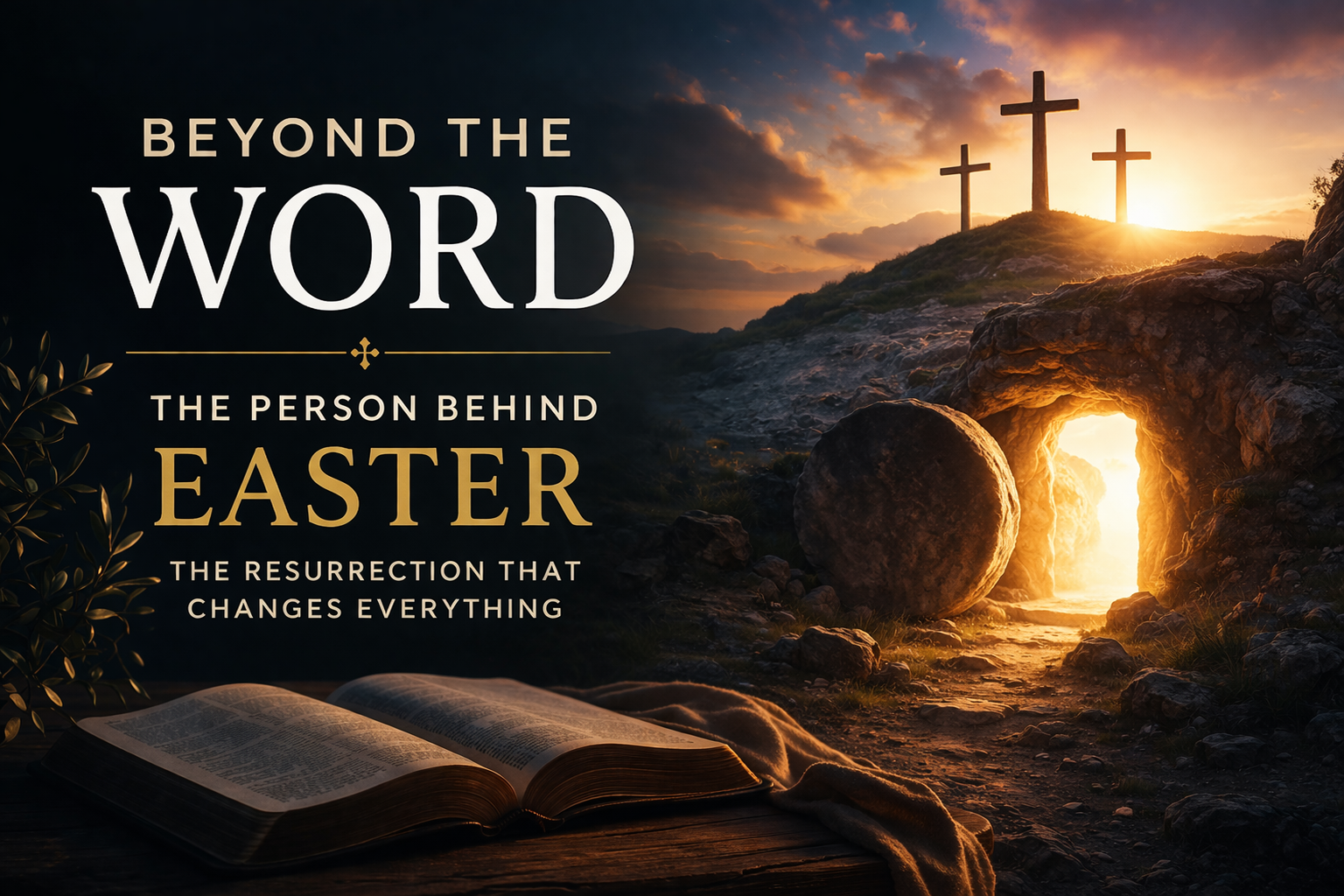
But perhaps the more important question is not about the word… but about the person.
Because Christianity was never built on mere words. It was built on a person. The person of—Jesus Christ.
You see, if Easter were merely about terminology, then its power would be linguistic. If it were about tradition, its influence would be cultural. But Easter is neither sustained by vocabulary nor confined to ritual. It is anchored in history—specifically, in the resurrection.
The profound claim of the Christian faith is this: that Jesus Christ, having been crucified, did not remain in the grave. He rose again. And in that act, something far greater than symbolism took place. A transaction occurred—one that addressed the deepest human dilemma.
For centuries, humanity has wrestled with the problem of guilt, of moral failure, of separation from what is good, pure, and holy. Philosophies have attempted to explain it. Religions have attempted to manage it. But the message of Easter declares that it was resolved—not by human effort, but by divine intervention.
The cross was not merely an execution; it was a substitution. And the resurrection was not merely a miracle; it was a validation.
It validated that the sacrifice was sufficient.
It validated that death was not the end.
And it validated that salvation was not an abstract idea, but a finished work.
This is why the focus cannot remain on the word “Easter.” Words can be debated. Origins can be disputed. But the person of Christ confronts us with something far more compelling—truth that demands a response.
The heart of the Christian message is not merely what is taught, but who is presented. Christianity does not ask you simply to accept a principle; it invites you to encounter a person.
And that changes everything.
Because if the resurrection is true, then hope is not wishful thinking—it is grounded reality.
If the resurrection is true, then forgiveness is not earned—it is offered.
And if the resurrection is true, then life is not ultimately defined by death—but by what lies beyond it.
So, the next time we hear the word “Easter,” perhaps we should pause—not to analyze its etymology, but to consider its implication.
Not the word… but the person.
Not the tradition… but the truth.
Because at the center of Easter is not a concept to be studied, but a Savior to be known.
“For God so loved the world that he gave his one and only Son (Jesus), that whoever believes in him shall not perish but have eternal life.” (NIV) – John 3:16
Happy Resurrection Day !!
 Affirm Truth